ISO 45001:2027 - What Is Changing and How to Prepare Your HSE System
· Last updated
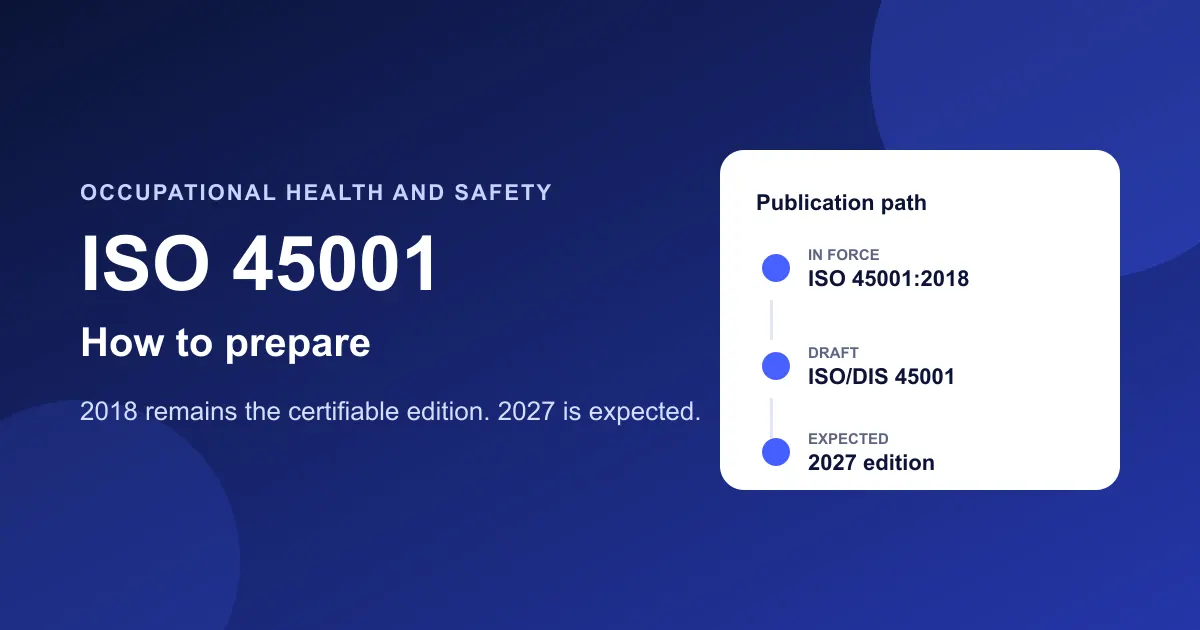
ISO 45001 is being revised, and the next edition is expected in 2027, so organisations in the UAE and wider GCC have a window now to get ready without disrupting current certification.
The revised standard is widely called ISO 45001:2027, but that is a market nickname. Officially it is still ISO/DIS 45001, a Draft International Standard. ISO 45001:2018 remains the current standard, and existing certificates stay valid. Nothing has to change today.
What has changed is the direction. The draft moves beyond preventing injury and ill health toward worker well-being, occupational health, psychosocial hazards, climate-related risk and tighter control of contractors. For companies that run multi-site operations, rely on contractors and manage multilingual workforces in extreme heat, those themes are everyday realities. This guide explains what is changing, what it means for UAE and GCC organisations, and how to prepare before the final text lands.
Quick answer: where ISO 45001 stands today
ISO 45001:2018, together with its 2024 climate action amendment, is still the only certifiable edition. The revision has completed its Draft International Standard (DIS) ballot but has not been approved as a final standard. ISO currently expects it to replace the 2018 edition in the first half of 2027, while LRQA points to mid-2027.
| Milestone | Status | Timing |
|---|---|---|
| ISO 45001:2018 (with Amd 1:2024) | Current, certifiable | In force now |
| DIS ballot (ISO/DIS 45001) | Voting and comments completed | Opened June 2026; closed late summer 2026 |
| Final Draft (FDIS) or revised DIS | Next step, not yet confirmed | Pending ballot outcome |
| Final standard published | Expected | First half to mid-2027 |
| Transition period | Typically three years; rules pending from Global ACI (formerly IAF) | About 36 months after publication |
Two points matter for planning. A draft standard cannot be certified, so anyone offering ISO 45001:2027 certification today is selling something that does not exist. And existing ISO 45001:2018 certificates do not lose validity because of the DIS.
What is changing in the draft
The proposed changes are moderate overall, but broader than the recent ISO 9001 and ISO 14001 revisions. The management system structure stays, and the draft aligns more closely with ISO's Harmonized Structure. Everything below comes from the DIS, so wording and clause numbers may shift before publication.
| Area | Proposed change | What it means in practice |
|---|---|---|
| Risk and terminology | The general definition of risk is removed and the OH&S risk definition is revised; "external provider" replaces outsourcing; new definitions for work-related well-being and disability | Update policies, procedures and supplier documents that use the old terms |
| Context and leadership | Climate action amendment moves into clauses 4.1 and 4.2; worker diversity and well-being feature in policy, consultation and participation | Review interested-party analysis and consultation arrangements |
| Planning | Hazard identification extends to new technologies, digital platform work, remote work, psychosocial and occupational health hazards, and climate impacts; new clause 6.3 on planning of changes | Refresh hazard registers and change-management records |
| Documented information | Records must show risk assessment results plus the methods and criteria used | Keep the method behind each assessment, not only the outcome |
| Occupational health | New clause 8.1.3 requires processes that protect worker health | Formalise health surveillance and fitness arrangements |
| Return to work | New clause 8.1.4 requires controlled support and monitoring after injury or ill health | Build a tracked return-to-work process |
| External providers | New clause 8.1.6 replaces the procurement clause, with expanded control of contractors and supplied products and services | Strengthen contractor onboarding, competence and performance checks |
| Communication and awareness | Information must suit different roles, abilities, locations and working arrangements | Check that training and notices reach contractors, temporary and non-English-speaking workers |
| Performance evaluation | Monitoring, internal audit and management review must cover the new areas | Add indicators for occupational health, well-being and contractor performance |
| Improvement | Clauses 10.1 and 10.3 are merged into a shorter revised 10.1 | Update clause references; intent is unchanged |
The draft's headline additions, as one summary puts it, are psychosocial risk and mental health, climate-related worker safety, hybrid and remote work, tighter control of contracted work, and gender-responsive safety.
What it means for UAE and GCC organisations
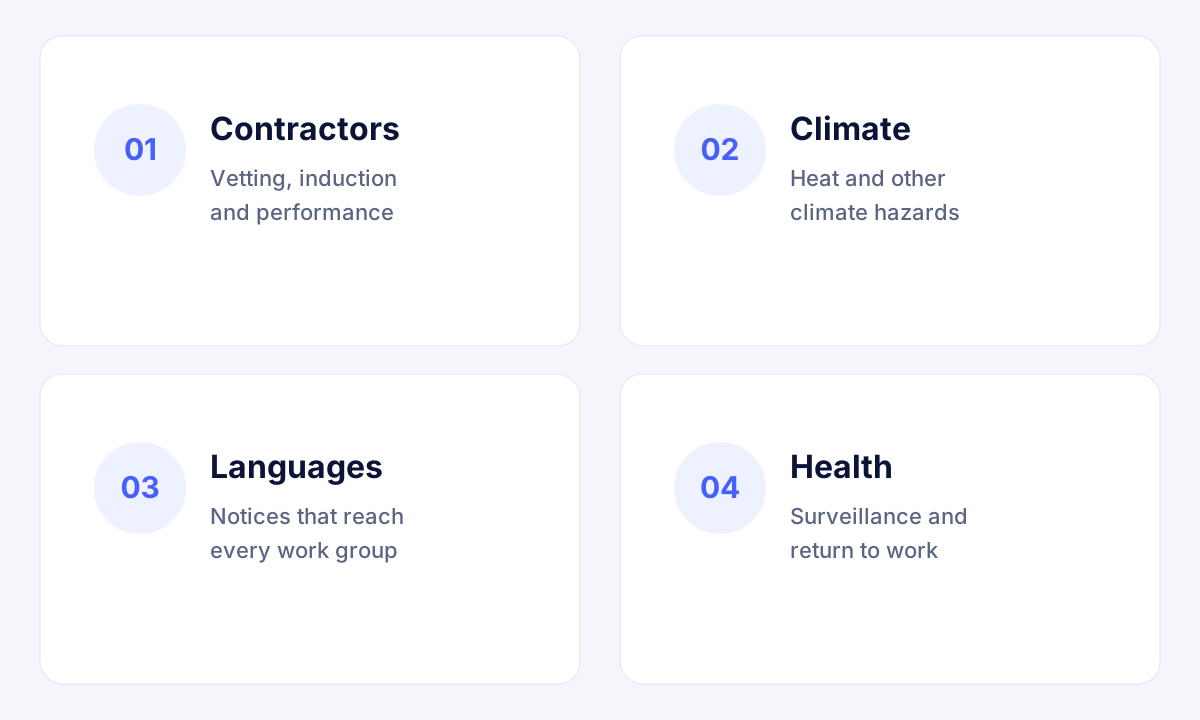
The draft's themes line up closely with how work actually runs in the Gulf, so the gap for many organisations will be in documentation and evidence rather than in intent.
Contractors carry the most weight. Large projects and contractor-heavy operations are a defining feature of GCC markets, and market research notes the region's emphasis on contractor management and centralised oversight. The new external-provider clause (8.1.6) puts that same area under closer audit. Expect auditors to ask how you vet, onboard, monitor and evaluate contractors, not only whether they hold a permit.
Heat is a climate-related risk you already manage. In the UAE, open-air construction work in direct sunlight is prohibited from 12:30 to 15:00 between 15 June and 15 September, with shaded rest areas, water and heat stress training required. The draft's broader attention to climate impacts means documenting how heat and other climate hazards feed into your risk assessments, not just your site rules.
Multilingual workforces test the communication requirements. The same guide notes that UAE construction site signage must cover at least Arabic, English, Urdu and Hindi. The draft expects information to be accessible for different roles, abilities and working arrangements, so toolbox talks, induction and incident reporting should be evidenced in the languages your workforce uses.
Occupational health and return to work are the newest burdens. Many organisations treat these as HR or clinic matters. Under the draft they become OHSMS processes with defined responsibilities, controls and follow-up.
Regulators and certification are separate tracks. UAE and emirate-level frameworks, such as OSHAD-SF in Abu Dhabi, set legal obligations independently of ISO. The revision does not change those requirements, but many organisations use ISO 45001 to structure their compliance and to satisfy clients and tenders, so aligning early avoids a rush later.
Looking for region-specific guidance on digitising HSE? See our pages on HSE software for the UAE and HSE software for Saudi Arabia.
How to prepare: a readiness checklist
The sensible approach is to keep maintaining ISO 45001:2018, monitor the final text, and use the months before publication to close the gaps the draft already signals. Avoid rewriting your whole system around draft wording that may still change.
Do now
- ☐ Confirm your certification body's transition plan and timeline for the revised standard
- ☐ Run a gap analysis of your OHSMS against the draft themes: occupational health, well-being, psychosocial hazards, climate impacts, return to work and external providers
- ☐ Review hazard registers and risk assessments for psychosocial, occupational health, climate-related and new-technology hazards
- ☐ Start recording the method and criteria behind each risk assessment, not only the result
- ☐ Map every contractor and supplier category to the controls you apply: vetting, induction, competence, monitoring, performance review
- ☐ Document how return to work after injury or illness is supported and tracked today
- ☐ Check that induction, training and notices reach contractors, temporary workers and each language group on site
- ☐ Identify the indicators you would add for occupational health, well-being and contractor performance
Do when the final standard is published
- ☐ Buy the final text and update clause references, definitions and terminology across procedures and supplier documents
- ☐ Update internal audit criteria and management review inputs for the new clauses
- ☐ Train internal auditors and process owners on the changes
- ☐ Agree a transition audit date with your certification body well inside the deadline
Organisations with several sites or integrated systems (ISO 9001, ISO 14001) should plan the updates together, since the revised ISO 45001 follows the same Harmonized Structure.
How digital HSE software supports the transition
Most of what the draft adds is a records and follow-up problem, which is where a digital HSE platform helps most. Spreadsheets and paper files make it hard to show method, consistency and evidence across sites and contractors.
| Draft requirement | What to look for in HSE software |
|---|---|
| Documented risk assessments with methods and criteria | Standard risk assessment templates, a central risk register, version history and audit trail |
| Hazard identification across new hazard types | Configurable hazard categories, including psychosocial, climate and occupational health |
| Planning of changes (6.3) | Management-of-change workflows with approvals and linked risk reviews |
| Occupational health (8.1.3) | Health surveillance and fitness-to-work tracking with restricted access to sensitive records |
| Return to work (8.1.4) | Case tracking after injury or illness, with actions, reviews and sign-off |
| External providers (8.1.6) | Contractor onboarding, document and competence checks, performance scoring and audits |
| Communication across diverse workers | Mobile, multilingual reporting and training records by language, role and site |
| Monitoring and management review | Dashboards for incidents, corrective actions, inspections and contractor performance, exportable for management review |
One caution applies to any tool. Software supports a management system; it does not make one compliant. Choose a platform that lets you adapt forms and workflows once the final standard is published, instead of locking in today's draft wording.
Audit evidence is where many ISO transitions get stuck. See how HSE audit software keeps inspection and audit records in one place, and explore SparkFlow's quality solution if you run ISO 45001 alongside other management systems.
Frequently asked questions
What is ISO 45001:2027?
It is the market name for the revised edition of ISO 45001, the international standard for occupational health and safety management systems. Officially the revision is still ISO/DIS 45001, a draft, and is expected to be published in 2027.
When will the new ISO 45001 be published?
ISO's current expectation is the first half of 2027, and some certification bodies plan for mid-2027. The date depends on the outcome of the ballot and the remaining approval stages.
Is ISO 45001:2018 still valid?
Yes. It remains the current published standard, and existing certificates stay valid. The draft does not replace it.
How long will the transition take?
A three-year transition period is usual for ISO management system revisions. Global ACI (formerly IAF) is expected to issue the binding rules, so confirm the details with your certification body.
What are the main changes in the revised ISO 45001?
The draft adds emphasis on work-related well-being, occupational health, psychosocial hazards, climate impacts and new technologies. It proposes new clauses on occupational health, return to work and externally provided processes, and tighter control of contractors.
Can my organisation get certified to ISO 45001:2027 now?
No. A draft standard cannot be certified. Continue with ISO 45001:2018 and prepare for the transition.
Should UAE and GCC companies act before the final standard is out?
Yes, with light-touch preparation. Run a gap analysis, strengthen contractor and occupational health controls, and improve risk assessment records, then update wording once the final text is published.
Prepare your HSE system for what comes next
If you are planning your transition, a short readiness review now saves time later. [Add brand, product and call to action here: for example, book a demo or request an ISO 45001 readiness checklist.]
Related reading: browse more guides on the SparkFlow blog.